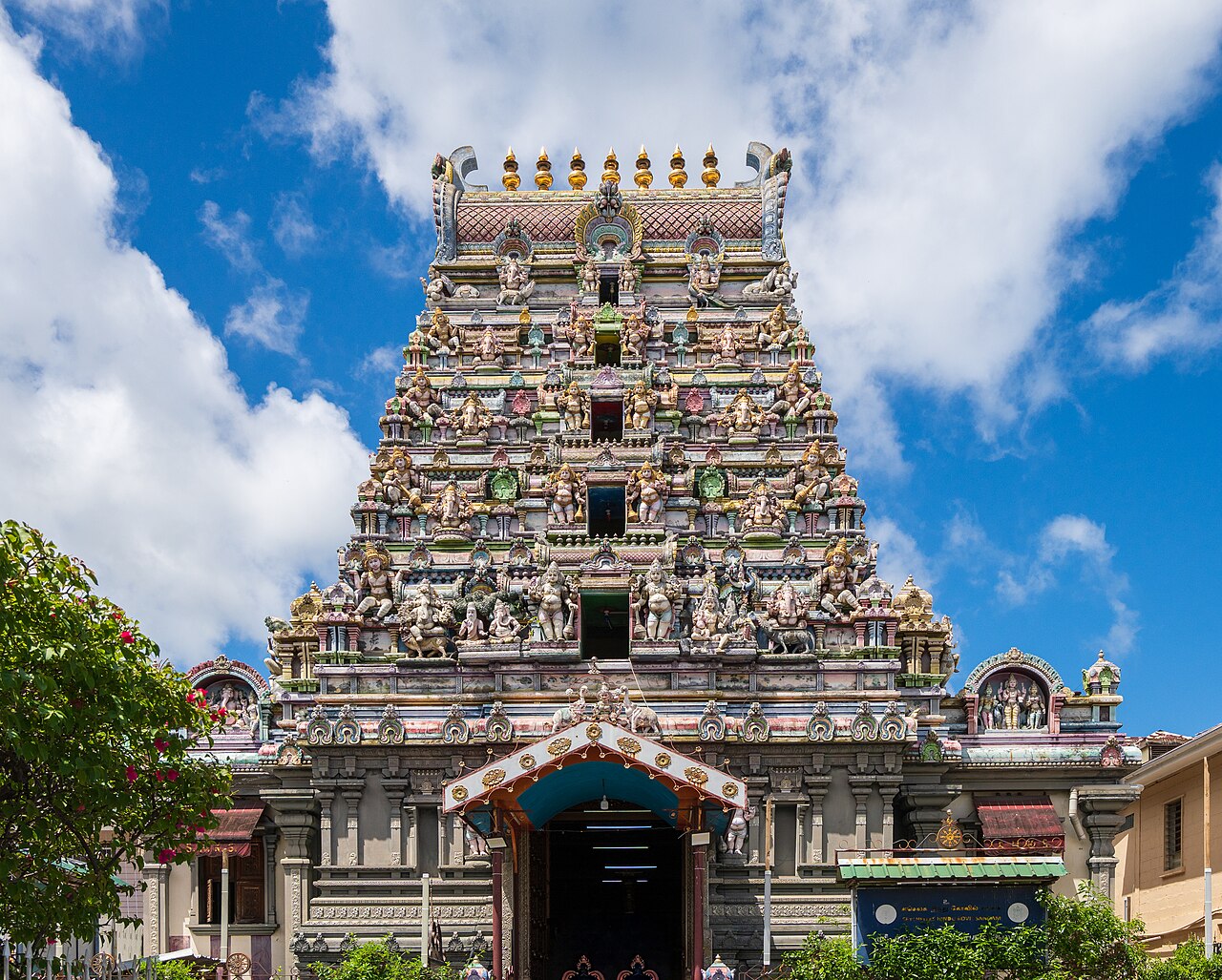
Consecrated in May 1992, the first and still the only Hindu temple in Seychelles.
The temple on Quincy Street
A Dravidian gopuram in the middle of a Creole capital, and the community that put it there.
One temple, and it is worth the walk
There is exactly one Hindu temple in Seychelles. It was consecrated in May 1992, it stands on Quincy Street in Victoria a few minutes' walk from the clock tower, and its gopuram is the most extraordinary thing in the middle of the capital.
Anybody can go in. It takes twenty minutes, it costs nothing, and it will be the only moment of the trip where the two halves of where you are and where you are from stand in the same frame.
The photograph above: NorbertNagel, CC BY-SA 4.0
What you are looking at
The tower over the entrance is a gopuram, built to the south Indian pattern, its tiers stacked and crowded with painted figures and topped with a row of gilded finials. Behind it the shrine follows the same plan a Tamil temple follows anywhere. What makes the sight strange is the background. Set the gopuram against a forested granite ridge and a Creole shopfront and it stops being ordinary.
The presiding deity has been Ganesha since 1999, which is where the name comes from. Vinayagar is Ganesha, the remover of obstacles. The inner mandapam also holds Murugan, Nadarajah, Durga, Sreenivasa Perumal, Bhairawa and Chandekeswarar, and prayers are made to each on the appropriate days.
Who built it, and when
The Seychelles Hindu Kovil Sangam was organised in 1984 and the temple was consecrated eight years later, in May 1992. Put that beside the census and the scale of the achievement is clear. There were 506 Hindus in the country at the 1987 census and 953 by 1994. A community of under a thousand people built a full Dravidian temple.
It was not a foreign gift and it was not built by a government. It was built by shopkeepers and traders and their families, most of them descended from the Tamil migration out of Tamil Nadu and Puducherry that followed the British-era shipping into Victoria.
Kavadi, and the holiday that is not the one you think
Taippoosam Kavadi was first held here in 1993, in the inner courtyard. It outgrew that almost immediately. It now fills the outer courtyard and goes out through the streets of Victoria as a chariot procession, and it is covered on national radio and television in both Tamil and English. It falls in January or February depending on the calendar.
Since 1998 the government has recognised it as a holiday for Hindus. That is a real and unusual thing for a state to do and it does not need exaggerating. Kavadi is not a national public holiday, and neither is Diwali. The statutory list is fourteen days long and all fourteen are Catholic or civic. If you are here for Diwali, the temple will be full and the rest of the country will be at work.
The days out
Island tours, boat days, snorkelling and walks, with real ratings, real review counts and free cancellation up to twenty-four hours before.
See the toursHow to visit without giving offence
Shoes come off before you go in, and so does anything on your head. Dress as you would for a temple at home, which in practice means covering the shoulders and the knees. Do not eat or drink inside. Ask before you photograph anybody, and do not photograph inside the sanctum.
Like most working temples it opens in the morning and again in the evening and closes through the middle of the day. We do not print times here, because they move with the festival calendar and a schedule copied off a listing site is the sort of thing that has people standing outside a locked gate. Go early in the morning. It is quieter and it is cooler.
Where it sits, and what is round it
Quincy Street runs off the middle of Victoria. The clock tower is a few minutes' walk away, the Sir Selwyn Selwyn-Clarke market is closer than that, and the bus terminal is at the bottom of the same slope. You can do the temple, the market and the clock tower inside an hour and still be back at the jetty for a boat.
That compactness is the point of Victoria generally. It is one of the smallest capital cities in the world and the whole centre is walkable in twenty minutes. Our day in Victoria puts the temple into a route with everything else worth stopping for.
Going on a festival day
Kavadi in January or February and Ganesh Chaturthi in August or September are the two days when the temple is not a quiet building you look at but a crowd you are standing in. Diwali brings lamps and a full house. If any of those falls inside your dates, go, and go early.
Park nowhere near it. Victoria has very little parking on an ordinary Tuesday and none at all on a festival morning. Take the bus in, or have a driver drop you and collect you later, which is the same advice we give for the market on a Saturday.
What it tells you about the country
A Catholic country of a hundred thousand people, with a statutory holiday list that is entirely Catholic and civic, let a Dravidian gopuram go up over the roofs in the middle of its capital, then recognised a Hindu festival as a holiday for the people who keep it, then let the procession use the streets.
That is the actual texture of the place, and it is more informative than any statistic on this site. Seychelles absorbed a Tamil merchant community, a Gujarati one, a Chinese one and a French one, and did it without any of them having to stop being what they were.
The temple on Quincy Street, in three frames.
Two frames of the temple and one of the street it stands on. Wikimedia Commons holds three free photographs of this building. The third is the one at the top of this page.
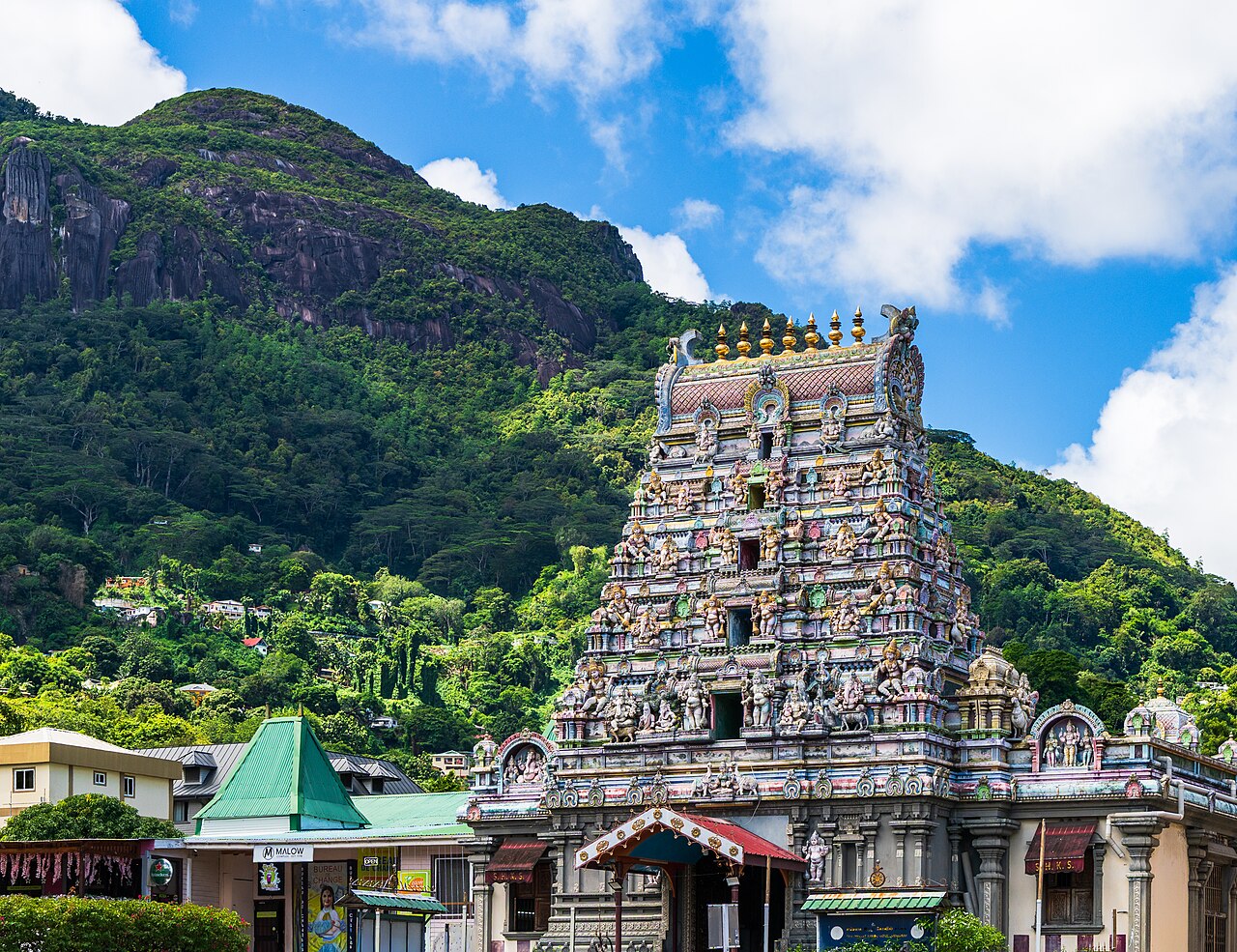
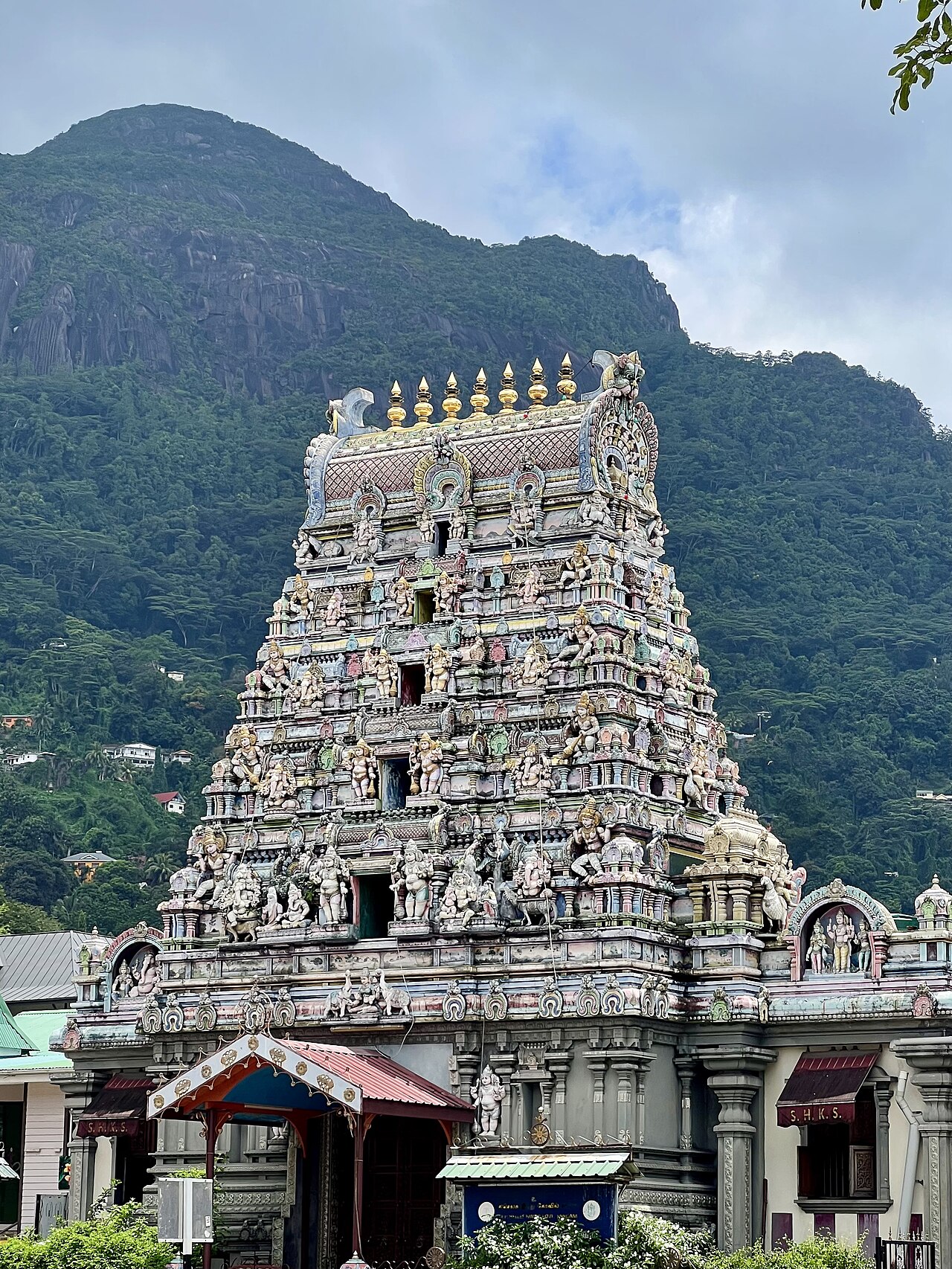
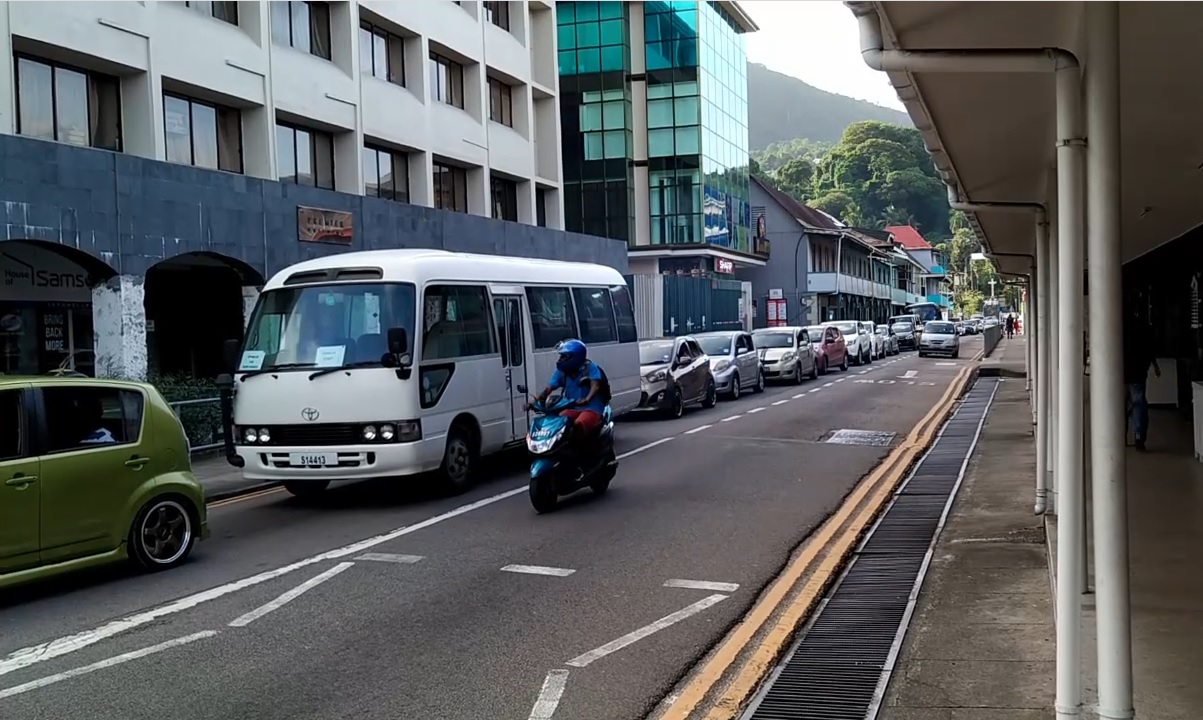
Photographs, under Creative Commons: NorbertNagel, CC BY-SA 4.0 Lindeby, CC BY-SA 4.0 Radosław Botev, CC0
What people ask.
Where is the Hindu temple in Seychelles?
On Quincy Street in Victoria, on Mahé, a few minutes' walk from the clock tower and closer than that to the Sir Selwyn Selwyn-Clarke market. It is the only Hindu temple in the country.
When was the Seychelles Hindu temple built?
It was consecrated in May 1992. The Seychelles Hindu Kovil Sangam that built it was organised in 1984, when there were fewer than a thousand Hindus in the whole country.
Can non-Hindus visit the temple?
Yes. Anybody may go in. Shoes and headgear come off at the door, shoulders and knees should be covered, and you should not eat or drink inside or photograph the sanctum.
When is Kavadi in Seychelles?
Taippoosam Kavadi falls in January or February, according to the religious calendar. It has been held here since 1993 and now goes through the streets of Victoria as a chariot procession. Since 1998 the government has recognised it as a holiday for Hindus.
Which deity is the temple dedicated to?
Ganesha, called Vinayagar, who has been the presiding deity since 1999. Murugan, Nadarajah, Durga, Sreenivasa Perumal, Bhairawa and Chandekeswarar are also enshrined.
Is the temple open every day?
Like most working temples it opens in the morning and again in the evening and closes through the middle of the day. We do not print times, because they move with the festival calendar. Go early in the morning.
Where every fact on this page comes from
- Ministry of External Affairs, Government of India, India-Seychelles Bilateral Relations, brief dated 27 August 2024, source
- High Commission of India, Victoria, contact and office hours, source
- Ministry of Foreign Affairs and the Diaspora, Republic of Seychelles, list of public holidays, source
- National Bureau of Statistics, Seychelles, Population and Housing Census 2022, source
- Hinduism in Seychelles, for the census religion series and the temple's consecration, source
- Seychelles microcontinent, for the rifting dates and the Deccan connection, source
- Seychellois rupee, for the 1914 currency ordinance, source
- Operation Flowers are Blooming, for the 1986 naval visit, source
- Seychelles, for the 1503 sighting and for the Seychellois account of the 1770 landing, source
- National Bureau of Statistics, Seychelles, Weekly Visitor Arrivals, bulletin VASB52 2025, released 31 December 2025, for the complete 2025 calendar year, source
- National Bureau of Statistics, Seychelles, Weekly Visitor Arrivals, bulletin VASB35 2026, released 2 September 2026, for the year so far, source
Six of these eleven are first-party. India's own foreign ministry, India's own High Commission in Victoria, the Seychelles foreign ministry and the Seychelles statistics bureau, the last of those three times over. Nothing on these pages comes from a travel site, a listing or a directory, and for most of these facts those were what search returned first. Every link was checked before publication. Figures move, so check the source rather than us if a number matters to a decision.
Put Victoria into the week properly
A morning in the capital works best with a car or a driver and a plan for where to leave it. Tell us the dates and we will write back with both.