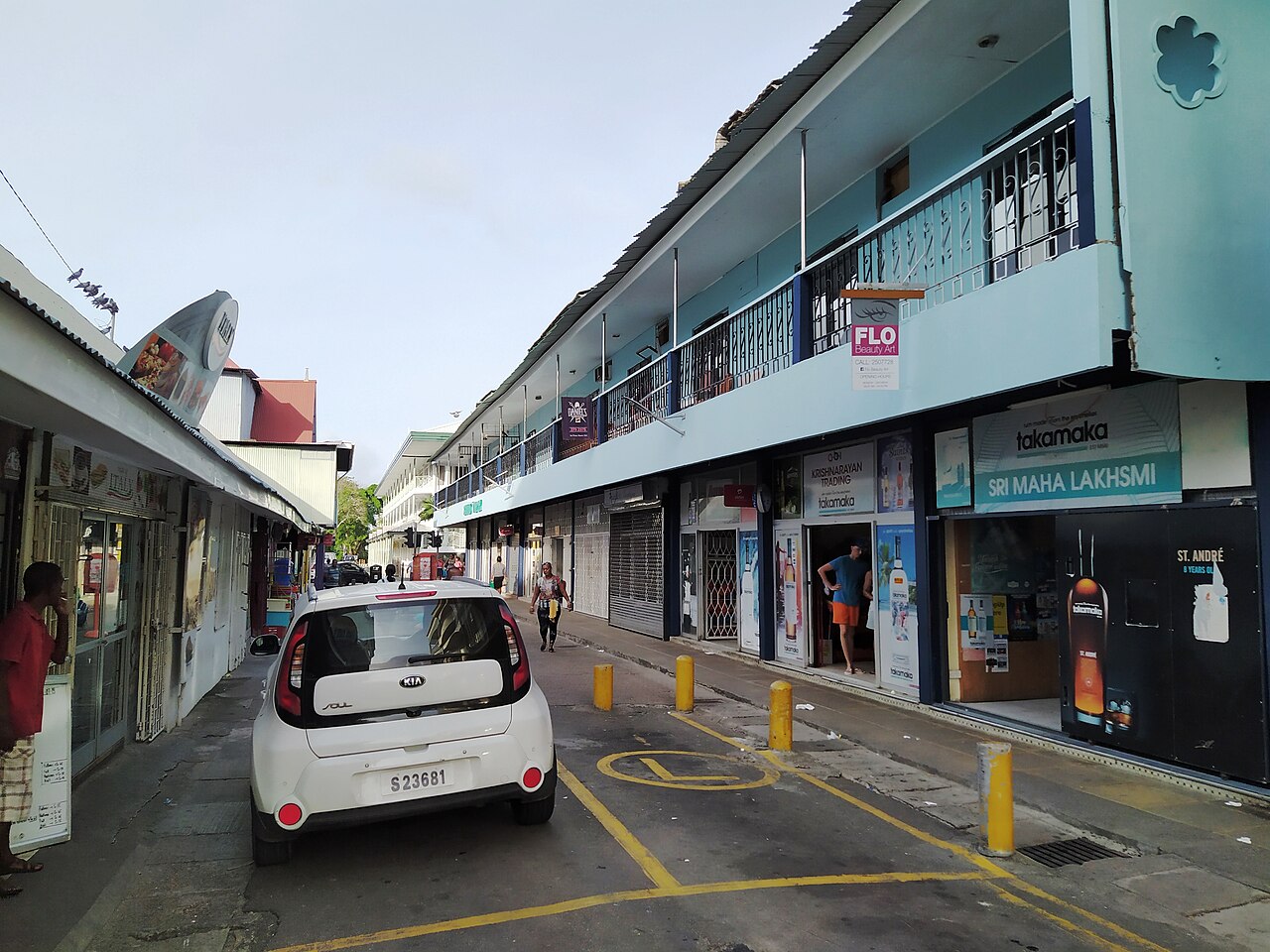
Read the shop signs on Market Street. That is the whole history in one walk.
The Indians who built Victoria
Five people in 1770, a merchant community that followed the British-era shipping, and the shop signs you will read on Market Street today.
Read the shop signs
Walk up Market Street in Victoria and read the fascias. Sri Maha Lakhsmi. Krishnarayan Trading. Keep going and there are more. That is not a novelty and it is not recent. It is the visible end of two hundred and fifty years of arrivals.
This is who came, when, from where, and what they built.
The photograph above: Radosław Botev, CC BY-SA 4.0
Five people, and then nobody for a century
The founding party of 1770 included five Indians, and after that the record goes quiet for a long time. The French period was a plantation economy worked by enslaved Africans, and there was no Indian migration into it of any size.
It was the British takeover that changed the pattern. After abolition the estates were worked in part by indentured labour brought from India, on the same model used in Mauritius, and on India's own account the islands were administered for a period from the Bombay Presidency, with regular shipping and a steady flow of goods.
The traders followed the cargo
Where the ships went, merchants went. The Indian trading community in Seychelles grew out of the East African diaspora, which had reached its own limits and was looking for somewhere new, and out of direct migration from the subcontinent. It came first from Tamil Nadu and Puducherry and later from Gujarat.
That order matters, because it explains everything you see. The temple is Dravidian because the first community was Tamil. India's own brief says the community is visible in every walk of life and dominates the trading and construction sectors. The two home languages you will hear in an Indian family here are Tamil and Gujarati, not Hindi.
What the census counted in 2022
There were 5,508 Hindus in Seychelles at the 2022 census, 5.4 per cent of the population, making Hinduism the second largest religion in the country. The growth is recent and steep. The count was 506 in 1987, 953 in 1994, 1,700 in 2002 and 2,174 in 2010.
It is concentrated. Cascade district is 20.1 per cent Hindu, Takamaka 9.4, Anse Etoile 8.1, Roche Caiman 7.7, Saint Louis 6.3. Several of the outer island stations, with populations counted in tens, are recorded as entirely Hindu, which is a statistical artefact of who works on them rather than a settlement pattern.
A car, delivered
Ten cars, no deposit, handed over at the airport, the jetty or your hotel. The small ones do the whole of Mahé and the Jimny does the hill roads.
See the fleetThree numbers that are not the same number
People mix these up constantly, and the mix-up is usually in the direction of overstating. India's brief of August 2024 estimated people of Indian origin holding Seychellois citizenship at around five thousand, and counted more than seven thousand Indian nationals here separately on gainful employment permits. The 2022 census put the whole population of the country at a little over 102,000.
None of those three figures is a translation of the others. Plenty of Seychellois of Indian descent are Catholic or Muslim rather than Hindu. Plenty of the permit holders are here for a contract and will go home. And a family that arrived in 1890 is not a diaspora in any useful sense any more, it is simply Seychellois.
Where the community shows up in public life
It is not confined to shopkeeping and never has been. Satya Naidu was the first Hindu member of the Seychelles National Assembly. Justice D. Karunakaran of the Supreme Court of Seychelles received the Pravasi Bharatiya Samman, India's highest honour for overseas Indians, in 2015, the second Seychellois to be given it after Dr V. Ramadoss in 2006.
In 2022 a statue of Mahatma Gandhi went up in the Peace Park in Victoria, standing among the figures of Nelson Mandela and Sir James Mancham, the first President of Seychelles. In 2018 the city of Victoria signed a twinning agreement with the municipal corporation of Panaji.
What that means walking round Victoria
Victoria is small enough to cross in twenty minutes and the Indian layer of it is in three places. The trading streets, which are Market Street and Albert Street and the lanes between them. The Sir Selwyn Selwyn-Clarke market, where the spice stalls and the produce are. And the temple on Quincy Street, a few minutes from the clock tower.
You can do all three in an hour. Our day in Victoria puts them into a walking route with the museum and the botanical gardens, and our vegetarian page explains what to buy in the market and what to carry from home.
The thing worth taking away
There is no Indian quarter in Victoria, no ghetto and no enclave. A Tamil grocery sits between a Creole takeaway and a Chinese hardware shop. Seychelles absorbed four or five migrations in two and a half centuries and did it without asking any of them to stop being themselves.
For an Indian visitor that produces a specific and slightly odd feeling. You are somewhere genuinely foreign, an ocean from home, and every so often you turn a corner and something is unmistakably yours.
The Indians who built Victoria, in three frames.
The market, the old trading row on Albert Street, and the bus terminal at the bottom of the same slope. Three sides of one square.
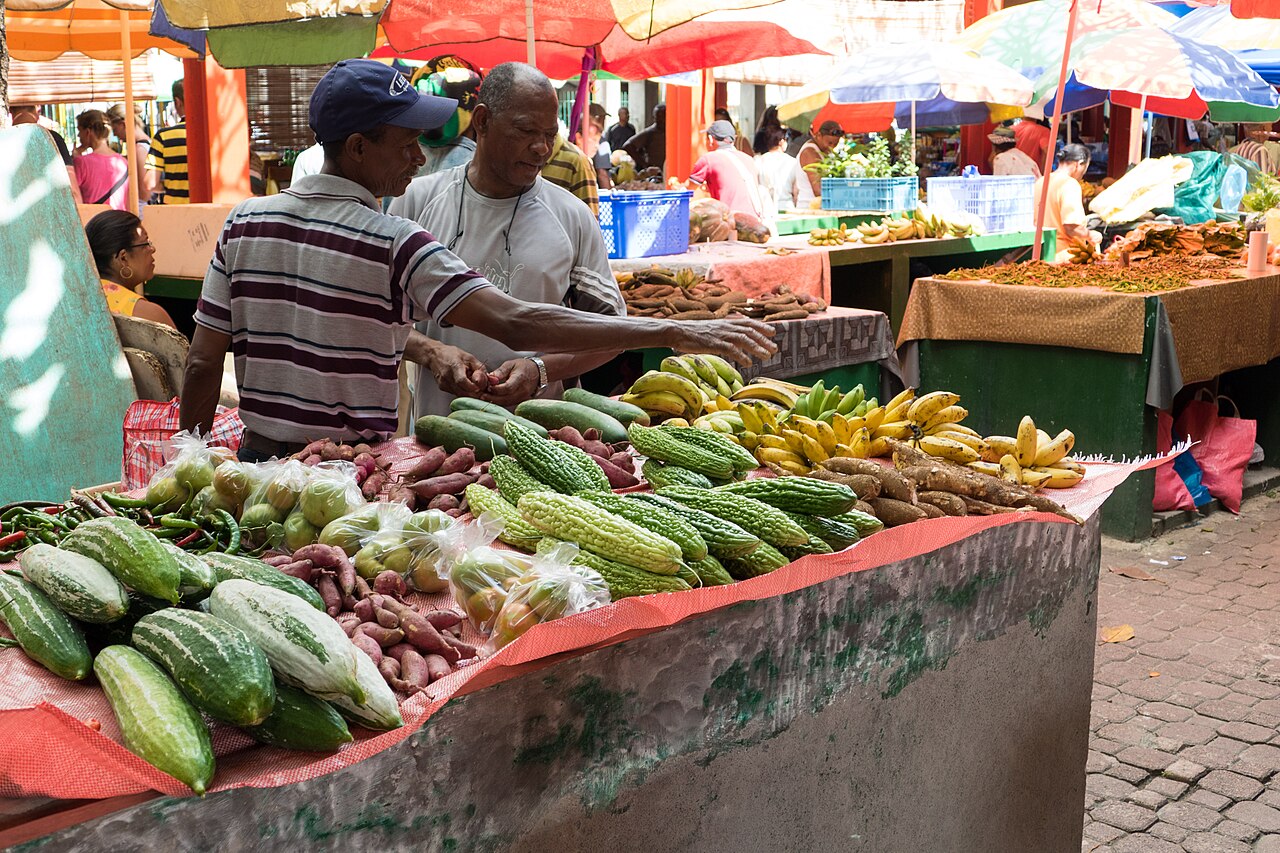
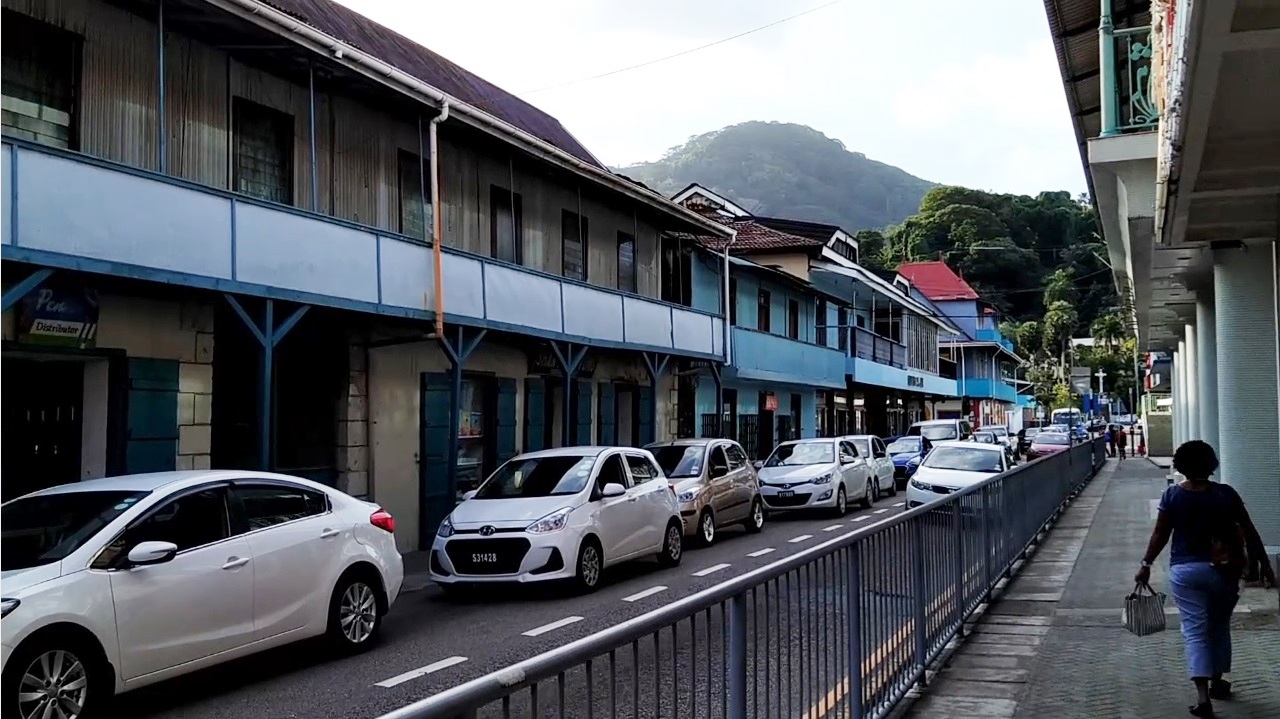
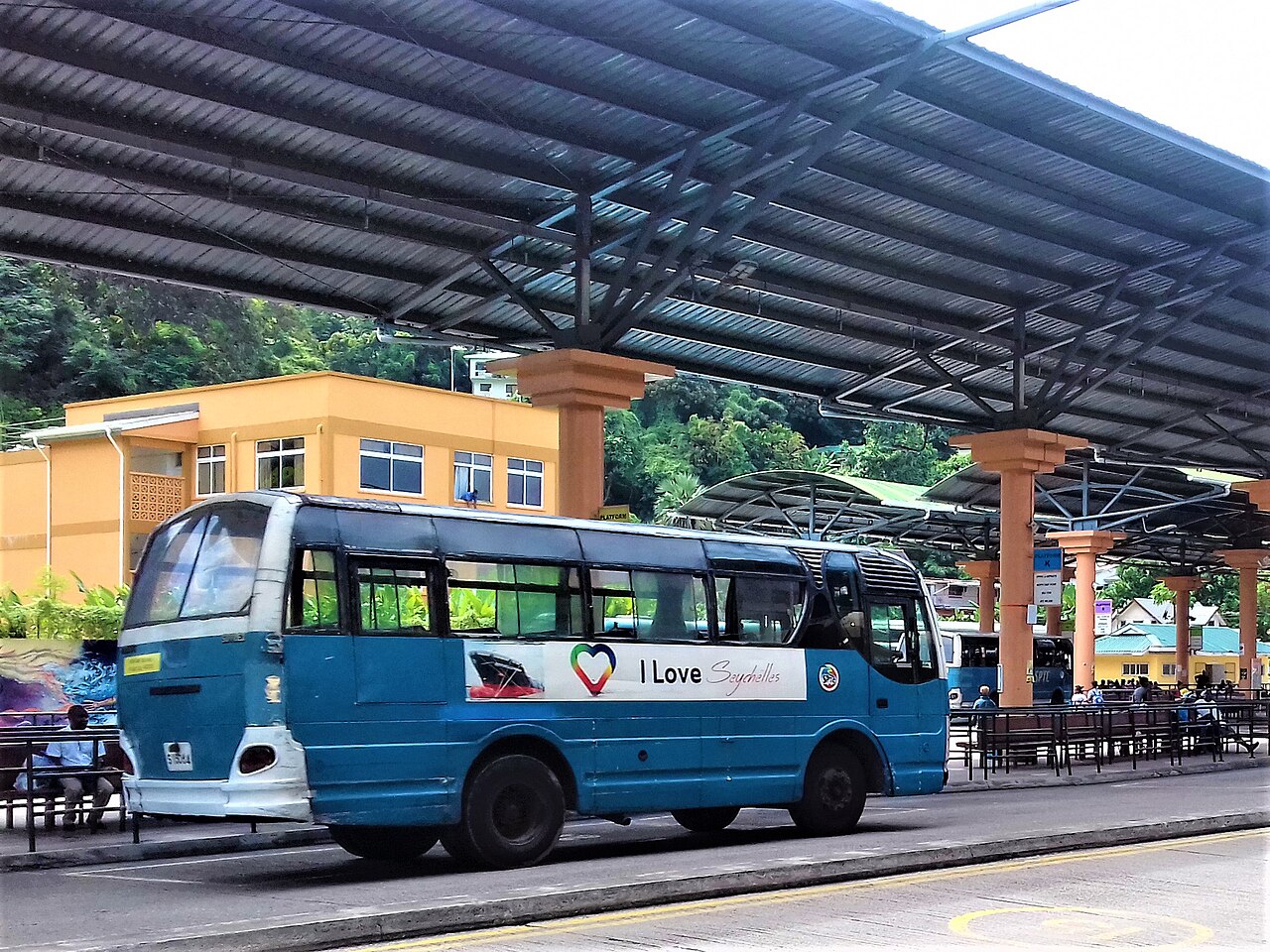
Photographs, under Creative Commons: So Seychelles, CC BY 2.0 Radosław Botev, CC0 Sarvesh Lutchmun, CC BY-SA 4.0
What people ask.
How many people of Indian origin live in Seychelles?
India's own brief of August 2024 estimated about five thousand people of Indian origin holding Seychellois citizenship, plus more than seven thousand Indian nationals on gainful employment permits. The 2022 census counted 5,508 Hindus, 5.4 per cent of the population, which is a different measure again.
When did Indians first come to Seychelles?
In 1770, with the first permanent settlement. India's foreign ministry records five Indians in a founding party of fewer than thirty people put ashore on Sainte Anne. Larger migration came under British rule, first as indentured labour and then as a merchant community.
Which parts of India did the community come from?
First from Tamil Nadu and Puducherry, later from Gujarat. That order is why the temple in Victoria is Dravidian, why the grocery and retail trade is largely Tamil-origin, and why the home languages you will hear are Tamil and Gujarati rather than Hindi.
Is Hinduism growing in Seychelles?
Sharply. The census counted 506 Hindus in 1987, 953 in 1994, 1,700 in 2002, 2,174 in 2010 and 5,508 in 2022. It is now the second largest religion in the country after Christianity.
Where is the Indian part of Victoria?
There is no separate quarter. The trading streets are Market Street and Albert Street, the market is the Sir Selwyn Selwyn-Clarke, and the temple is on Quincy Street four minutes from the clock tower. All three are within a twenty minute walk of each other.
Are there famous Seychellois of Indian origin?
Satya Naidu was the first Hindu member of the Seychelles National Assembly. Justice D. Karunakaran of the Supreme Court of Seychelles received the Pravasi Bharatiya Samman in 2015, after Dr V. Ramadoss in 2006.
Where every fact on this page comes from
- Ministry of External Affairs, Government of India, India-Seychelles Bilateral Relations, brief dated 27 August 2024, source
- High Commission of India, Victoria, contact and office hours, source
- Ministry of Foreign Affairs and the Diaspora, Republic of Seychelles, list of public holidays, source
- National Bureau of Statistics, Seychelles, Population and Housing Census 2022, source
- Hinduism in Seychelles, for the census religion series and the temple's consecration, source
- Seychelles microcontinent, for the rifting dates and the Deccan connection, source
- Seychellois rupee, for the 1914 currency ordinance, source
- Operation Flowers are Blooming, for the 1986 naval visit, source
- Seychelles, for the 1503 sighting and for the Seychellois account of the 1770 landing, source
- National Bureau of Statistics, Seychelles, Weekly Visitor Arrivals, bulletin VASB52 2025, released 31 December 2025, for the complete 2025 calendar year, source
- National Bureau of Statistics, Seychelles, Weekly Visitor Arrivals, bulletin VASB35 2026, released 2 September 2026, for the year so far, source
Six of these eleven are first-party. India's own foreign ministry, India's own High Commission in Victoria, the Seychelles foreign ministry and the Seychelles statistics bureau, the last of those three times over. Nothing on these pages comes from a travel site, a listing or a directory, and for most of these facts those were what search returned first. Every link was checked before publication. Figures move, so check the source rather than us if a number matters to a decision.
See it on foot, with the driving sorted
Victoria has almost no parking and the market is finished by mid-morning. Tell us your dates and we will price a car or a driver around the day you want.